
Alison Bramwell: Co-curating Transformation by Victoria Taylor
Interview with Holly James
Transformations is the retrospective of the lost artist Victoria Taylor, who despite withdrawing from the art world has remained a prolific painter throughout her life. Introspective and rich with symbolism, the collection maps out the difficult life of an exceptionally strong woman, an artist ahead of her time. Now living in care after a devastating stroke that left her unable to paint, Victoria’s work is finally being shown after a lifetime away from the public eye. Holly spoke with her niece Alison, who’s curating the exhibition at New House Art Space, to understand more about Victoria’s life and artistry.
Holly: Hi Alison it’s lovely to meet you! We’re so excited to see Victoria’s work in the gallery next week. How are you feeling about the upcoming exhibition?
Alison: I'm hugely excited about it, it’s wonderful, really really happy. It’s very important. She’s a fabulous lady, she’s so lovely. I exhibited her work a few years ago when I got to know the Marina Hotel in Dover, because I stayed there when I came down to see Vicky, and then they gave me the back room there to display her work. But people wanted us back. It went down really well in the community, we had local art dealers coming and they loved it, and they told me to categorise it, I learnt a lot about artwork. It was quite nice to put an exhibition on because that was a new string to my bow, I’d never done that. It’s really perked her up, I can’t wait to tell her about Guildford, and I can’t wait to do it.
Holly: How did Transformations come into being as a collection?
Alison: Vicky had a stroke when I was in my first semester of my masters. There was nobody in the family to help her, and I was free, so my cousin in America said, “Why don’t you go and help her?” So I did. I had to sort her house out which was really difficult, and there was all her artwork. And I knew she’d done her painting forever and it’s fabulous work, and I realised it just had to be out there. So I phoned a local gallery, he came and looked and fell in love with them. They exhibited it there but it was during Covid so the only people who came were locals, and her friends from the band. After that I put it away for a bit because I was busy studying, but I thought ‘I’ve got to exhibit again, I’ve got to get it out there’, and I happened to be speaking to somebody at the hotel in Dover about it, and they said “Well, why don’t you exhibit here?”
People liked the exhibition, so all of a sudden I became an arranger, it was quite fabulous. I put all the nudes in a little room and I put chairs in there and it gave people an atmospheric view of the trauma she’d had. So I did it again, and I used to go around giving out her brochures wherever I was, even for an appointment. Because really, it’s got to get out there.
Holly: Victoria graduated with her masters from the Royal College of Art in 1968, but she decided early on not to exhibit her work in public - why was this?
Alison: I think she was too worried about being judged. Your art is your psyche on paper really. So she only exhibited once or twice. I think the world wasn’t ready for it then. I think she’d have been slated a lot with all the nudes. And now in the care home, if she got any negative feedback I wouldn’t tell her anyway. She’s protected where she is, though there’s been absolutely no negativity.
When she got to the care home they worked with her and put her in a separate room, where she gradually regained capacity. This was a couple of years ago. I could talk to her for the first time in ages. We used to have such long conversations about spirituality, Vicky was hugely spiritual, hugely. She changed my life, because I was very closed off and into business, and it was Vicky who opened up a door for me, and my life's been absolutely wonderful since. But she admitted to the care home she was sexually abused as a child, and we come from a bit of a karmic family with a history of that. And basically, Vicky ran away at 14 to London. In Birmingham she’d done her art but then Grandad kicked her out; he didn’t understand it. So she went to London, rented a garage, lived in it and just painted. And she’s so talented.
Holly: How did Victoria’s painting style develop throughout her life?
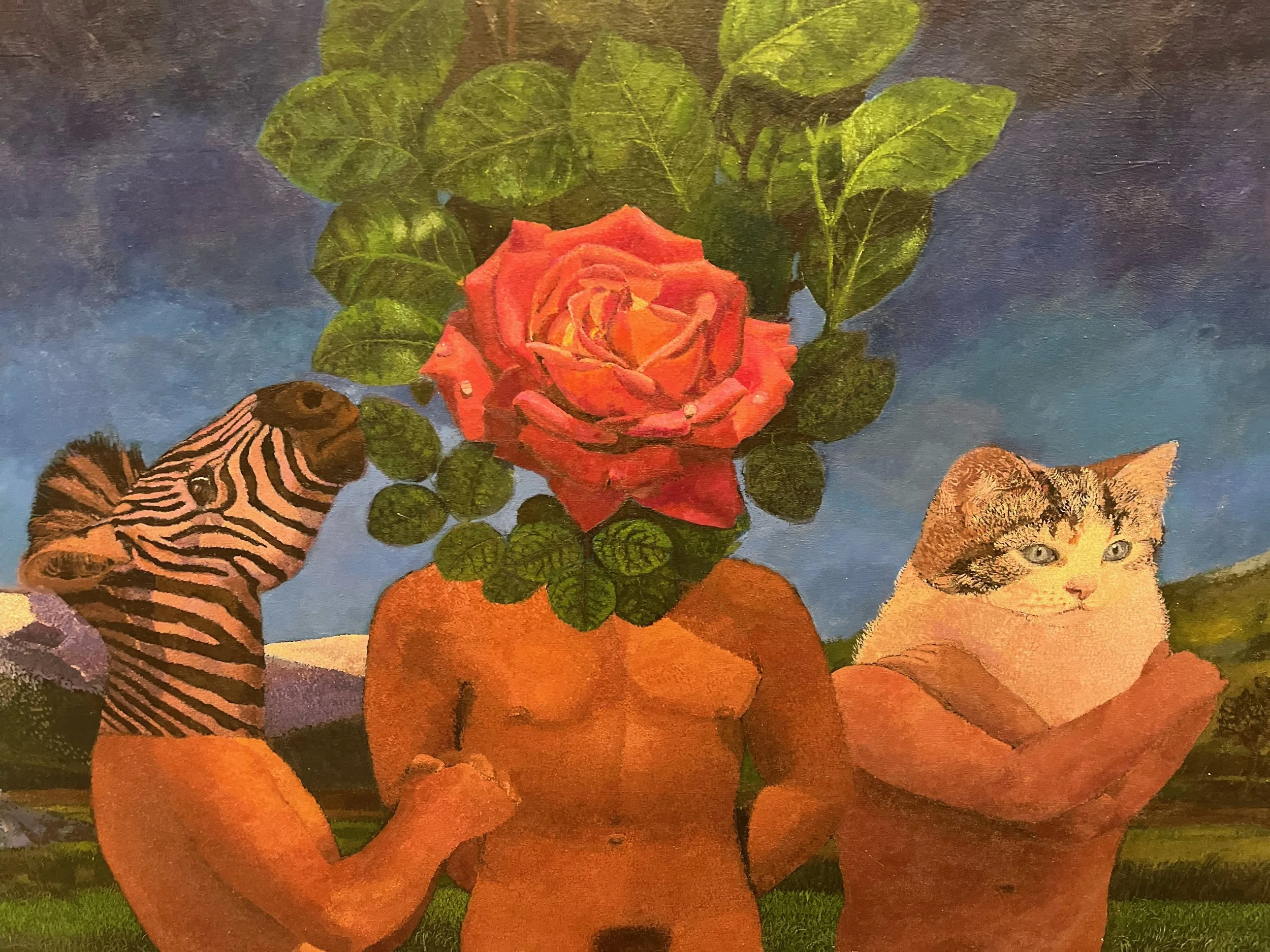
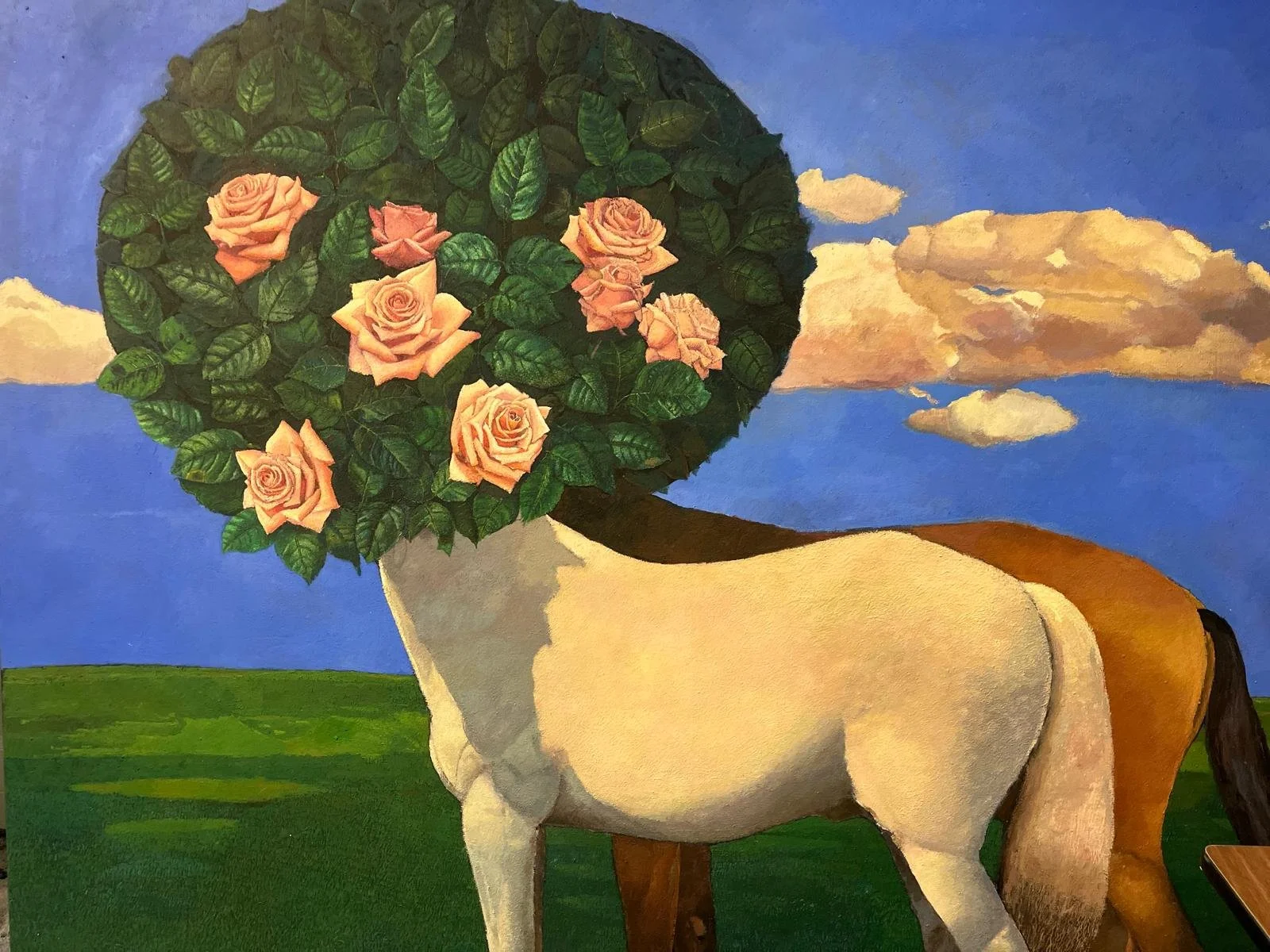
Alison: You can see the stages, because she started with the nudes, then she went onto the faces, and then she moved onto horses and lions, because she’s inspired by Rembrandt. I found some Rembrandt copies when I sorted her paintings out. There were so many paintings, she just never stopped. Although she loved the violin. The only other thing she really did was the violin. Very talented woman.
Holly: Very creative all round. Wow. So for viewers of the exhibition who’ll be seeing these animal motifs: do they have any meaning, or are there other underlying themes?
Alison: This is the thing I think is down to peoples interpretation, especially with the animal heads and the nudes. Everybody interprets it differently which I’ve found fascinating. Somebody would say, “Oh, in the nudes there’s always two” you know, referring to sexual abuse, and then somebody would say, “Oh they’re animal heads because that’s a way of dysmorphing”, you know, a human person. Somebody else noticed that the animal heads went from kittens to aggressive lions, kittens to cats.
With the nudes I put the chairs out in the area and it was literally a room with all the nudes, there’s about 8 of them, and I just let people sit there and take it in. And I’d go in and ask, what d’you think of that? Because I wanted to get their feedback. And it was brilliant. Everybody comes back with a different interpretation. And I'd asked Victoria, though I don’t think she can think that deeply at the moment, it’s difficult to question her about her art now because she’s had a lot of stroke damage. But actually, with the exhibition she said, “Keep it small, not too many paintings.” She knew that. I did sit with her and we went through which ones. And she said, the floral and the flowers, she thinks they’re boring.
Holly: Really!? I can’t believe that.
Alison: Yep, and yet they’re really vibrant and beautiful. But to her they’re boring, she said. She liked the horses the best. There’s a lot of this gone on over the years, this sort of artwork with the animal heads, it’s like a metamorphosis.
Holly: So stylistically where would you say that Victoria’s work sits? It seems kind of surrealist, but then you say she was influenced by Rembrandt…
Alison: Yeah, I think she’s got her own style really. They love her in the home, she’s the only one who tells them where to go. She’s quite strong. And I really believe it’s because we’ve done so much creativity, and released so much that way. I’ve done acting for years, and Vicky’s done her painting all her life, and I really believe it can release an awful lot of pent up emotions. Funnily enough I was thinking about it the other day, that we’ve probably come out the strongest out of most of our family, mentally, from doing that.
When I was talking to some kids on the ferry today, I was so sad to hear that their creativity is being reduced. We’re gonna get a lot of frustrated people, youngsters, people if they don’t have that avenue. And you’ve got all these extra groups, but you have to pay. It isn’t accessible. A lot of the people who’ve had trauma don’t have any money. So I find that very prejudiced in that way. In fact we’re losing a lot of painters. Painting is something that really isn’t encouraged, and yet, to know Vicky how she is in the home, she won’t stand for nothing. And I believe that’s because she’s painted out her life, her trauma on paper. And that’s why again, creativity needs to be encouraged and not discouraged, because we need to open up the mind, not control it. And Vicky would say exactly the same.
Holly: I’m with you there! So how aware is Victoria of this exhibition and what are her feelings around it?
Alison: Yeah, she’s degenerating quite quickly now, every time I see her it’s more of an effort, but when she regained capacity she was fine, we just tootled along for a while talking about food, she loves her cream cakes and she loves her stilton and crackers, and I take them in every week. But when we started to exhibit properly and I showed her the Dover one, she really perked up. A woman at the home who works with her said that she changed in an instant, that she could see the sparkle in her eye. She was so excited. And she’s still aware of that now, she’s always saying, “Really appreciate it, thanks so much.” I get so much thanks from her.
Holly: Oh I’m so pleased to hear that, and that she’s finally getting exposure now.
Alison: Yeah she deserves it!
Holly: 100%, and it’s great that she’s aware and part of it. So to round off, what do you hope that viewers will take away from the exhibition?
Alison: I think it’s just, it’s her whole life, she never did anything else. She used to freedance when she was little, and I think that was her first spark, and then art. And then at 14 she left, fled to London, and she never did anything different. She didn’t paint for a long time after she lost her son, and I think now, she just finds it hard not being able-bodied, not being able to do anything, not being mobile. She was used to doing her violin and everything, it’s sad really. But that was having the stroke you see, what can you do? So I think it’s the dedication of a whole lifetime, so many paintings in storage, a lifetime of trauma relief, her whole journey.
Transformation: Victoria Taylor will be on display in the gallery at Newhouse Art Space between the 10th-15th April, 2026.