In July we welcomed the brilliant Liana Fricker to New House, who hosts a series of interviews with inspiring creatives titled In Conversation With. This interview is taken from an evening with artist Claire Knill and musician Julian Deane, which we’re recalling ahead of their collaborative gallery installation this November.
Liana: Hello everyone, thanks for coming and sharing your Friday with us. I'm Liana Fricker, your host this evening, and ultimately our conversation tonight is about the phoenix rising from the ashes. I've invited Julian and Claire to join me for this conversation, whom I've met along my professional journey and who've become friends and collaborators.
We wear so many labels and titles, and I started thinking to myself, ‘Well, how former is former really?’ Former marketing director, former music manager, former, former, former. But we take a lot of those experiences with us along the way, and it seemed to be a fitting metaphor with which to look at Claire's work and the collaborations that Claire and Julian do together alongside their individual careers.
Claire Finds Sculpture
Liana: I want to start with the artwork. Claire, can you tell us about your sculpture art, and how you went from going to art school, not doing art, and then becoming an artist?
Claire: I did Textiles at university and because it was textiles, there was a leaning towards fashion. I went and worked in London in fashion PR, and found myself in events and travel. I had my own event business, and a lot of the time was making props or things that we might have fabricated. So I was making those, and remembering this connection to hands that I'd forgotten how much I loved.
I then did freelance events and started developing an art practice. And these pieces came out. I loved the idea of three-dimensional pieces that you could walk around, so I was tinkering in the studio, making wall hangings and playing with light and shadow, trying to work out how I make something that has a moving composition. And I've been making these ever since.
How The Mobiles Work
Claire: They're all hand-balanced. I make them from the bottom to the top, and you balance each section and piece as you go. I hand cut the pieces out of sheet material, which I love using because you get this profile that appears and disappears as the pieces turn. I layer as I go, and a lot of the making is actually observation, like with any art. But to tell whether they're working or feel good, because that's what I'm making for, I sit down and watch them. And actually, over time, that space to sit and observe, to be quiet, to be centered in one space has become a large part of the reason that I make them.
Within that I'm looking at how the shapes interact, how colours come together, what happens when the colours and shapes pass. I love using apertures that you can see through. So it's all about movement, a sense of impermanence, and moving through something.
Liana: You used the word practice. Why choose that word?
Claire: In what I do, I'm repeating something, changing something. And I guess, anything you're learning, it's a constant evolution, isn't it?
Julian Rediscovers Music
Julian: Going from music management into sound artist, it wasn't like one door closed and the other opened. But COVID kind of closed the door on me a bit. For twenty years, I've managed bands, and it was full on, super fun, and we released loads of records and toured everywhere. But I didn't know there was a choice not to do that because I was so deep in it. Once you're in that lane, if I wasn't on a midnight train back from East London on a Tuesday, it was weird.
During COVID, I bought a piano. When Toploader ended, I had a kid, carried on making a bit of music for a bit, got into music education, got into management, and I didn't touch an instrument. And then I bought this piano where my dad grew up. I saw one on Facebook, and thought, "Winchester Piano. I should get that. It's COVID. I love playing the piano. I haven't played it in years."
In Toploader, Joe the singer is an amazing keyboard player, so you hire these amazing instruments. But guitar players touch guitars and amps, and if I go into Joe's territory and play an old Wurlitzer…in a band you're sort of segregated. So me getting my own piano was a big thing, and I'd not played for such a long time. So just because of COVID, I did a thing that I wanted to do when I was twenty, but I did it when I was fifty instead.
Has anyone heard of Robert Fripp? He has a very disciplined approach to guitar play. You tune your strings in a way you'd never tune them normally, so the instrument becomes a new thing. And it's all about minimum effort for maximum results. The fingering becomes important, and slowness. Playing one note with quality is a thousand times better than a hundred without quality. So that became quite a profound experience. I've done this course that's really gone into my head, and I just started playing slow and then never changed unless I was confident I'd know where I was going.
And that’s informed this collaboration that’s becoming more real. Now I'm making a proper record, but it's one step at a time. Working with Claire earlier this year suddenly brought all this together. But it's only that first brave step that allows things to happen.
Identity and Labels
Liana: I love that. And it brings us to the core question of the evening, which is what are the limits of who we think we are, and are they more flexible than they feel? Because I know for myself, having gone from working in fashion PR similar to Claire, then working in creative agencies, then because I just had no idea what I wanted to do next, I was like ‘I'm going to do it for the plot. I'll move to Surrey and have a baby, and I'll figure the rest of it out later because I don't want to decide right now.’ And this just seemed to make all the sense in the world.
For a really long time, I didn't think I wanted to be a mom, and if anything, I was very sure I didn't want to, and yet that was the choice that I made. And I never thought I wanted to have my own business, and then that was the choice I made. And looking back, I think a lot of that internal resistance was almost like more self-protection. If I say I don't want it, I don't have to deal with maybe not being able to have it, or if it goes wrong, or I fail, so I can just reject that immediately.
And what I've learned is there's more flexibility in my identity, in all our identities and these labels. The idea that you're looking back and realising that actually you did study textiles, but it's always been three-dimensional.
Courage to Change Paths
Liana: One thing that I want to touch on is confidence and courage. Do you remember a moment in any of your careers where you had the confidence and courage to reject something and say, "I'm not going to do that anymore?”
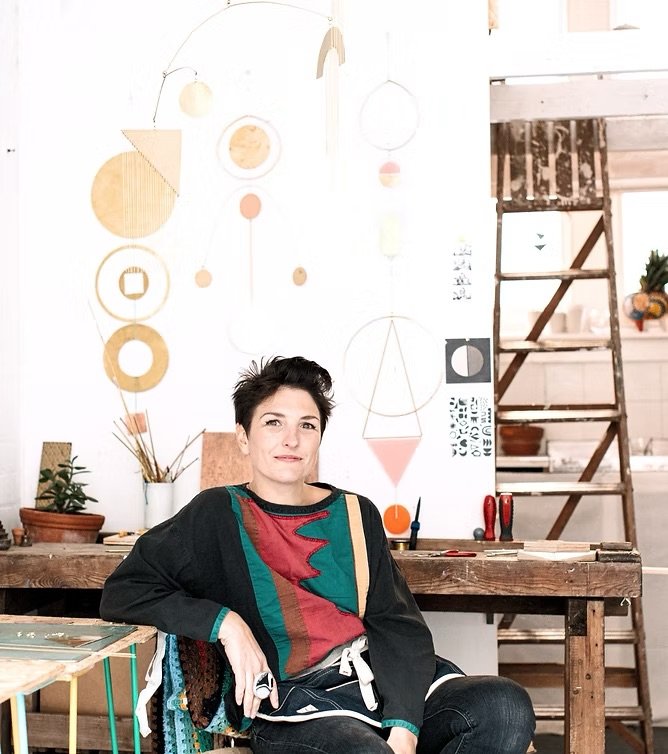
Claire: Yeah, I think when I’d worked in a startup for about five years, and I'd had a conversation with a friend about doing this together if we had a business, and I was just like, "Do you know what? I'm going to quit. I don't want to do this job anymore." And so me and my friend ended up having more serious conversations about what it could look like. It was a leap of faith to do it yourself. But that decision, even though scary at the time, was part of the tapestry of being here now, and doing something that I really love.
At one point I will just be a full-time artist and I won't do the events anymore, but we need those two things. I love doing my art, and it involves lots of people, and on-the-spot decisions and all the things that come with that. And the other is me on my own in the studio, basically processing and just sitting there by myself. So now there's actually a really nice literal balance of these two things coming together. And my event work now comes into the art side of things, because I'm now producing my own events and I know how to market my work.
Julian Leaves Toploader
Julian: Well, the band split the first time. We'd had a massive record and obviously a massive single. And we peaked. We'd gone so tabloid. It was just like everything I'd hated we'd become. So there was a huge sense of relief when that ended. And we actually all found out it had finished when we read it in The Sun. Literally on the bus to the tour bus. Looking back it was time.
And then we reformed eight years later after getting together for a stag do and I did leave that time. It wasn't that it was bad, but by this point I was accepted into the music industry as a manager. So I left then and was speaking to my wife, we had two young sons, and it was potentially a lot of money over the years that I walked away from for these small festivals. But it was just right. I really didn't want to be the person I was ten years before.
Liana: And then the moment where you decided to publicly come out and say, "Actually, you know what? I'm walking away from music management, so you might want to manage my artists." It went viral.
Julian: Again, you talked about a practice, and I think I've been trying to establish this a bit as a writer, mostly as a musician, but a bit as a writer and a filmmaker. So what happens if I commit some time to it?
So yeah, Luke's cousin I've managed until a month ago for 15 years. I've auditioned him for film with Ace Young, the producer from Brighton when he was 17. I've known him a long time. It's a good relationship. And we were going into his sixth album. I wanted it to be great, but I didn't want it to be seeking. I wanted to do my own thing. And on the back of that, I wrote this essay which was literally platform nine, three hours.
It's like bus admin, I'll go to a co-working space and then I've written another essay. I ran it by Luke, and then I posted it just before Great Escape, which is a big music industry thing. So here I've got this guy that I love, who's brilliant and an amazing writer and producer. We've developed him over a long time, he's lived in LA. I didn't want him to not have good representation. So I dropped it on Substack, just before Great Escape. And I didn't want virality, but I think it really resonated with a lot of people who are feeling stuck in the music industry, and don't know how to get out.
Vulnerability and Growth
Liana: Within the development of your art as practice and then putting that out into the world, charging for it, whether it's tickets to a show or the actual artwork, how have you managed that? I guess as you're stretching within the vulnerability and putting yourselves out there? What does it feel like?
Claire: I think working as I do now is about a process. It's about self-discovery, material. In previous careers or jobs, I've felt I had to know it all. Maybe it's also age and experience. Now I know I can show up, and if I don't know what I'm doing, that's something I can deal with, and people aren't gonna judge, and it doesn't matter.
Liana: As your stages are getting bigger, do you feel like you're actually getting more comfortable with the beginner's mindset?
Julian: I feel like that, yes. I feel like the process is fulfilling, right? The reason for Woodchester Piano Company is because I made a secret record, but I've got no design skills, so I took a photo of my piano and that was the sleeve. I was really worried what my music industry friends would think of it, even though I've got a billion streams as an artist. It's like my identity is so entrenched, I'm an industry guy, and yet I’m not.
How The Collaboration Began
Liana: Tell us about your collaboration. Claire and Julian have been working together, bringing sound art and sculpture art together. How did that happen?
Julian: We met at the summer camp, and then you were curious about sound in relation to your art. So we just met and talked locally.
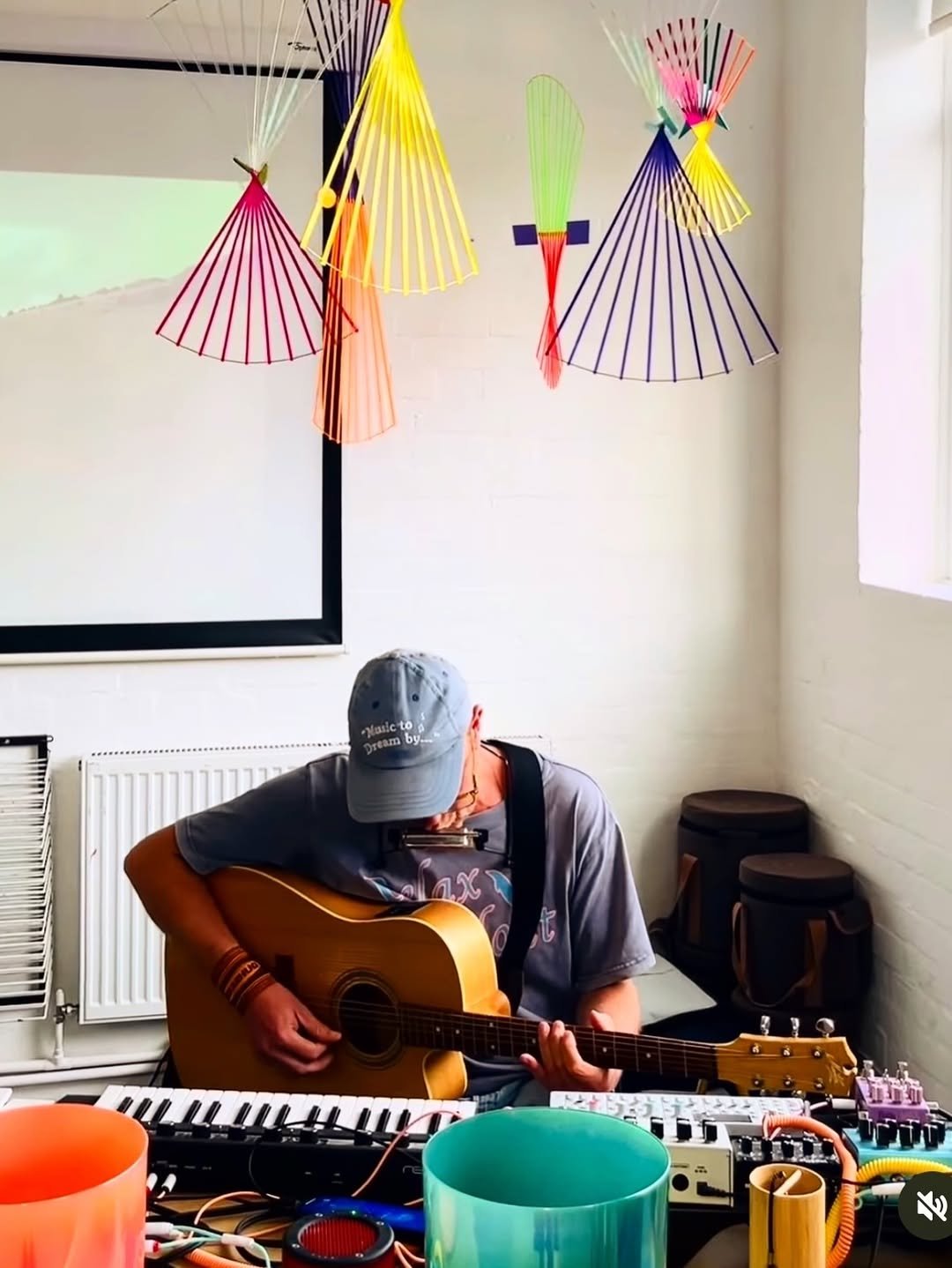
Claire: I was quizzing you about how I get these to make sound digitally, and then I had an exhibition that I was doing that was about movement and stillness, and you came and did this soundscape sound bath. It was gorgeous. And then we had a chat about creating something together where our two art forms were more integrated, and that was about the experience of being in a space with Julian's sound, with my mobiles, and how that would work together.
Julian: Again, it's a lot of the problem we were talking about in terms of imposter syndrome and confidence, and suddenly it’s shared. How could I not want to promote this as the visual representative of my music? So it suddenly becomes easy. The collaboration element enables you to back your own project much more. We both really like that shared responsibility means that when people like it, they like both our work. So yeah, we've definitely talked about how we can create something.
Advice For Transitions
Liana: Before I open it up to some questions, I just want to round out with, what would you say to someone in transition thinking about shedding the current layer of themselves, going into something new?
Julian: My artistic brain is that, and having managed lots of bands, if you want success financially and artistically, I think it's inevitable that you have to go all in somewhat. A lot of the musicians I know who’re great but spend too much time in wedding bands, kind of pick up the ticks of that, if you know what I mean? So that kind of, ‘there is no Plan B’ is a good strategy, and what's worked for me. But it depends on where you're at in life, doesn't it? 10 years ago, give me a band of 28-year-olds who are amazing and everyone wants to sign them. I'm probably gonna go, "Give it time. Their lives are changing, and it won't work." But if they're 18, you've got 10 years before reality strikes.
So I think it is a transition. It's rare that a rage quit will turn into a great business immediately. But when you find something worth pursuing, you pursue it. Not at the expense of everything, but maybe you don't take the shift at the bar you're working at because you wanna spend the day writing.
Claire: You have to back yourself, even if you feel self-doubt.
Read more about Julian’s work in response to Claire’s sculptures in his Substack post here.